
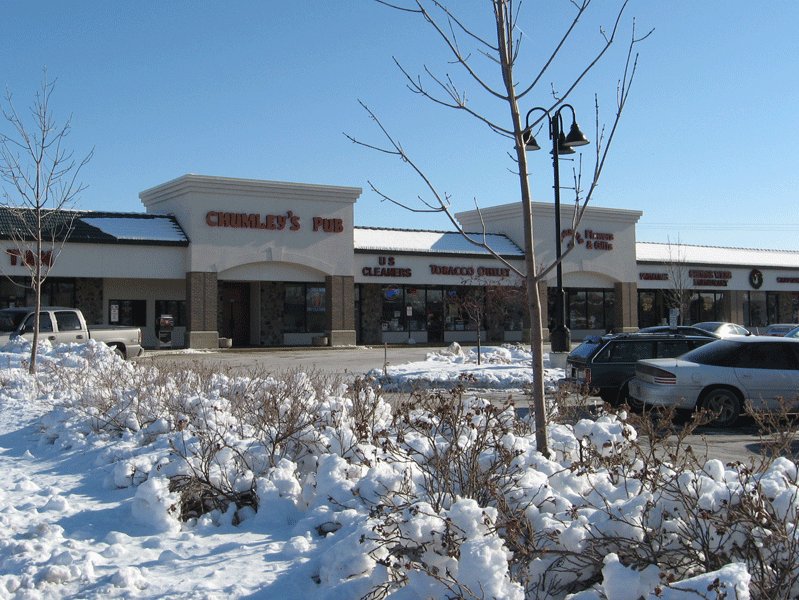

People who grew up in Milwaukee proper have seen a lot of changes in the city during the past decades, but those who grew up outside of the city have arguably seen even more. Many watched their neighborhoods transform, for better or worse, from wide-open spaces to a collection of subdivisions, big box stores and strip malls.
In this ongoing series, natives of Milwaukee’s outskirts recall what it was like to grow up in these areas and how they’ve changed. For the first segment of “Then and now,” the focus is on New Berlin.
“There’s been a lot of progress and growth in New Berlin. Some of it welcome, some not,” says New Berlin Mayor Jack F. Chiovatero.
Today, the city of New Berlin -- located in Waukesha County -- is 39.6 square miles and has a current population of around 40,000. According to the 2000 census, the racial makeup is 95.84 percent white, 2.31 percent Asian, 1.56 percent Hispanic and .44 percent African American. The median household income is $67,576.
Chiovatero says the population boom and increase in household income began in the ‘60s with the development of the New Berlin Industrial Park, which employed thousands of people.
“(The industrial park) put New Berlin on the map. It became an incubator for a lot of companies,” he says.
The success of the New Berlin Industrial Park triggered the construction of the West Ridge Business Park, which brought even more workers -- and their families -- to the New Berlin area. The new corporate park offered more white-collar jobs, and, consequently, the demographic and housing stock changed considerably in New Berlin.
“Houses have gone from the smaller, blue-collar type home to the much larger, white-collar, professional home,” says Chiovatero.
New Berlin native Renee Bebeau, 38, has a similar sentiment. “There were more rednecks then suburbanites when I was growing up,” she says.
Because of its incredible growth, has New Berlin reached it capacity? Chiovatero says not yet.
“There’s still lots of room for development of residencies,” he says. “And some room for new business on the south end of the city.”
Chiovatero, who was elected as New Berlin’s alderman in 1999 and became the mayor in 2005, says the development of National Avenue is perhaps the most prominent example of the city’s growth.
“It went from a two-lane country road to a four-lane, urban road,” he says.
Bebeau lived in New Berlin in the early ‘70s and again in the late ‘80s for her final year of high school.
“I lived in New Berlin the first time when I was just going into kindergarten. My family lived in the Brittany Apartments on Calhoun Road, across from the fire station, and then we moved into a big, scary, old house on the corner of Cleveland and Calhoun,” says Bebeau.
The “big, scary, old house” Bebeau refers to was transformed into a public haunted house after her family moved out and eventually burned down.
“My family was living in Texas at the time the house burned down, but my grandma sent us the clipping from the newspaper,” she says.
“So much had changed in New Berlin in general, but the apartment complex hadn’t changed at all, and appears to be the case to this day,” says Bebeau.
Although Bebeau says she’s not interested in living there today, she has some positive memories of New Berlin.
“I remember going to Chumley’s Pub on Moorland on the night before Thanksgiving. It was the place to go to see people from the past. The same people, year after year, it was like a time warp,” she says.
Cyndi Wilder grew up in New Berlin and worked at Chumley’s for a few years. She relates to the “time warp” aspect of New Berlin.
“When I turned 18, I got out of there,” says Wilder. “But it seems most people from high school are still there.”
As a child, Bebeau spent a lot of time with her grandparents, who also lived in New Berlin.
“I remember walking to Holy Apostles Church to visit my grandpa’s grave with my grandma,” she says.
Unlike the city in Germany, New Berlin is pronounced with an accent on the first syllable instead of the second. Interestingly, the subcontinental divide cuts through the center of the city, so the eastern half receives Lake Michigan water and the western part uses well water.
Most adults who grew up in New Berlin spent a lot of time in nature as children.
“It was like living in the country,” says Rick Phelps, 47. “I tell people I lived in the country to this day, and when I say New Berlin, they laugh.”
Wilder, 42, witnessed a lot of change to New Berlin’s landscape, too.
“The fields I used to run through are now condos (on Moorland and Beloit Roads) and they knocked down the houses I used to ride my bike by and turned the area into the (West Ridge) industrial park,” says Wilder.
Phelps says New Berlin has the same small-town friendliness, even though the demographic has changed.
“I think the progress has been good for New Berlin. It brought more money into the city and yet the people who live there are still very much into community,” he says.
Wilder says she spent lots of time in Calhoun Park as a child.
“I used to catch frogs, and get lost for hours in Calhoun Park. It was a different time then,” she says. “And I remember waking up and seeing two horses in my backyard, Thunder and Lightning, who had escaped from down the block.”
High school, however, was less enchanting for Wilder.
“I went to Eisenhower, and it was very cliquey. There were basically three groups: freak, jocks and frocks,” she says. “The people whose parents were the most permissive about partying were the most popular.”
Wilder says she felt like differences weren’t tolerated, so most of the students conformed to a particular “look.” The “look” represented the demographic of that time, which was less affluent than it is today.
“That meant black Gass shoes and burning the end of your black eyeliner pencil so you could cake it on as darkly as possible, on the inside of your eyelid,” she says.
Wilder remembers a large tank in front of the New Berlin VFW that was usually unlocked. She and friends would climb into it and actually rotate it.
“That was the best part of New Berlin for me: I had so much freedom and access to nature, something my kids don’t have living in the city,” says Wilder. “And I still love those parts of New Berlin, the parts that haven’t been trashed. But unfortunately, most of it went from magical to industrial.”
Molly Snyder started writing and publishing her work at the age 10, when her community newspaper printed her poem, "The Unicorn.” Since then, she's expanded beyond the subject of mythical creatures and written in many different mediums but, nearest and dearest to her heart, thousands of articles for OnMilwaukee.
Molly is a regular contributor to FOX6 News and numerous radio stations as well as the co-host of "Dandelions: A Podcast For Women.” She's received five Milwaukee Press Club Awards, served as the Pfister Narrator and is the Wisconsin State Fair’s Celebrity Cream Puff Eating Champion of 2019.
