
Sign in | Register now | Like us on FacebookLike Us | Follow us on TwitterFollow Us

Milwaukee's Daily Magazine for Saturday, May 25, 2013

Fri
Hi: 56
Lo: 42
Sat
Hi: 57
Lo: 42
Sun
Hi: 59
Lo: 48
Advertise on OnMilwaukee.com
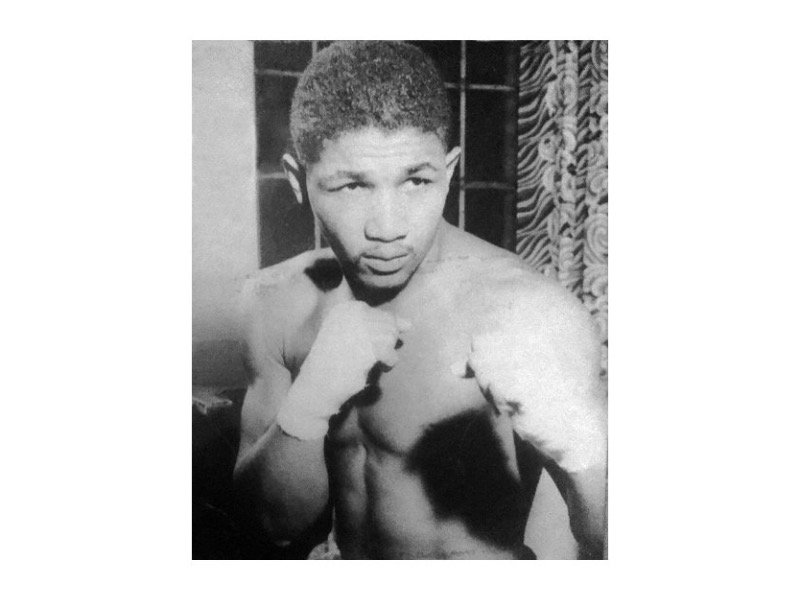
The Urban League boxing team in 1953 when Norman Johnson, standing second from right, won his first state Golden Gloves title.

Norman Johnson, former Golden Gloves champ, passes away

Reporting on Norman Johnson’s 11th knockout victory in his 12th professional fight at the South Side Armory on October 9, 1955, The Milwaukee Journal’s Bob Teague wrote that before James Sparkman "assumed the prone position for 10 counts in the second round,
he had been floored twice. And judging from his expression after the second trip down he had decided that he did not belong in the same ring as Johnson."

That was a decision often made by opponents of Johnson, the sensational Milwaukee lightweight who passed away last Friday about three weeks short of his 78th birthday. Some made it a whole lot sooner than Sparkman did.

"Guys came down from up north, and when they found out they were matched against Norman they’d say, ‘I’m not fighting him!’" recalled LeRoy Allen, Johnson’s friend and stablemate at the Urban League gym on 9th and Vine Streets. "He was very aggressive and could hit hard."

In 1953 and ’54, Johnson won the Wisconsin Golden Gloves 135-pound title with first round knockouts. He was named "Outstanding Boxer" of the ’54 tournament, and both years he was runner-up in the National Amateur Athletic Union tournament in Boston.

After scoring first round knockouts in his first two pro fights in 1954, Johnson fought a draw with 35-bout veteran Al Cervantes at the Milwaukee Arena in a fight refereed by then- heavyweight champion Rocky Marciano. Then Johnson ran off 11 more knockouts before losing his first fight on points in St. Louis.

Johnson’s ferocious style made him a favorite at the Arena, Auditorium  and South Side Armory. He quit boxing in 1959 with a record of 18-6-1. Fourteen of Johnson’s victims weren’t around for the final bell. Among the lucky few was Eddie Perkins, who lost a six-round decision to him at the Arena on Dec. 27, 1956.

Johnson knocked Perkins down twice in the third round. Not many did that to Perkins, a defensive wizard who reigned as world junior welterweight champion in the 1960s and is now enshrined i…

Read more...
Mary Ehrmann passed away on March 2.

Remembering Mary Ehrmann

Already reeling from a fusillade of self-inflicted blows, the Milwaukee Archdiocese took a resounding haymaker to the gut with the death of Mary Ehrmann on March 2. For almost four decades my younger sister was an iconic teacher in the elementary grades at several area Catholic schools, and the number of lives she changed for the better is incalculable. In and out of the classroom she was always direct, challenging, entertaining and exasperating -- sort of like John Wayne in a pantsuit, only more dauntless and formidable.

Mary loved her profession so much that when she took a job at a Milwaukee public school many years ago it lasted just a few weeks because the weak-in-the-knees-and-brain principal insisted that her primary duty was to keep the students from killing each other. "I want to be a teacher, not a referee," she told him when she turned in her resignation.

She might’ve become a world-class golfer, but her favorite hole was the 19th. She unapologetically hued to her own path, even when there were neon warning signs. After surviving breast cancer she continued to smoke cigarettes, and it was cancer that took her down just four days before her 60th birthday. While her judgement was sometimes open to question, her heart never was.

Devoutly Catholic, Mary offered up her final months of intense suffering for "pagan babies." Her very last words to me were "I love you," but I cherish just as much what Mary told me during enervating end-of-life medical treatments whose side-effects included a condition requiring her to take a nuclear laxative.

If the results were all she hoped for, said my always funny and acerbic sister, "I’ll name it after you."

Boxing ref Milt didn't preen or showboat, and let his professionalism speak for itself.
Boxing ref Milt didn't preen or showboat, and let his professionalism speak for itself. (Photo: shutterstock.com)

Milt Rickun: An old-school fight referee

Compared to some of the high-profile, self-promoting boxing referees who came after him, Milt Rickun was a shrinking violet in the ring when he refereed professional and amateur bouts at the Milwaukee Arena, Auditorium and Eagles Club in the 1950s, '60s and '70s.

Guys like Mills Lane and Joe Cortez sought as much face time and notoriety as the fighters they policed, even developing and marketing their own pre-fight catchphrases ("Let's get it on!" for Lane; "I'm fair but firm!" for Cortez).

Rickun, who died Dec. 7 at age 85, was properly inconspicuous between the ropes. He didn't preen or showboat, and let his professionalism speak for itself.

The biggest fight Rickun refereed was on Aug. 3, 1970, when ranked light heavyweight contender Andy Kendall met local favorite Ron Marsh before a standing-room-only crowd at the Eagles Club. It went 10 rousing rounds, and in the story about it in the next day's Milwaukee Journal Rickun's name wasn't mentioned at all. In the Sentinel, reporter Ray Grody mentioned him once, noting that Rickun "did an excellent job."

A street fighter growing up on Milwaukee's North Side, Rickun boxed as an amateur after joining the U.S. Marine Corps in World War II. He turned pro in the late 1940s, but his dream of "being one of the great fighters of all time" was unfulfilled thanks to a glaring anatomical deficiency Rickun described to Zak Mazur of The Wisconsin Jewish Chronicle in an interview a decade ago.

"Every fight I ever had as a pro ended in a knockout. Either I stopped them or they stopped me. I was a knockout puncher with a glass jaw."

When he became a licensed referee, Rickun told Mazur, "I loved it almost as much as boxing."

And he did it the correct old-school way: almost invisibly.

Local boxer and artist Sylvester Sims died Saturday.

Boxer/artist Sylvester Sims dies

Sylvester Sims never forgot George Vandenberg, whose punch in the face was the answer to Sims' prayers.

One of Milwaukee's foremost artists, whose paintings exhibited and sold in galleries throughout the country and are included in the corporate collections of the Northwestern Mutual Life Insurance and Miller-Coors Brewing Cos., Sims died Saturday at his Northwest Side home. He was 83.

His artistry with a paintbrush made Sims a legend in the local African-American community where he was born Dec. 21, 1928, though it is probably more accurate to say that it gilded the legend Sims first forged as a multi-sport athlete in the 1940s.

One of eight brothers and four sisters, Sims attended the Ninth Street School across the street from the headquarters of the Milwaukee Urban League at North 9th and West Vine Streets.

"That was my hangout," he said in a 1994 interview. At the Urban League he got his first formal art training in classes, and also began boxing under iconic coach Baby Joe Gans, whose teams ruled the state amateur boxing scene from 1937 until Gans' death in 1959.

"I'd practice boxing in the gym, go home and eat, then go back to the Urban League for art classes," said Sims.

Sims excelled at every sport he put his hand to. In 1944 he became the first African-American to win a state Amateur Athletic Union high-diving championship, and he also won track, weightlifting and bodybuilding titles. Later he would play semi-pro football for the Milwaukee Brown Bombers ("Every position except quarterback, and I could out-pass all of them").

But all his athletic triumphs didn't trump the frustration and humiliation Sims felt because he was born with severely crossed eyes. As a youngster, he said, "I prayed all the time, believe me. Lots of times I'd be sitting on the river bank praying that my eyes got straight."

When he was 11, Sims underwent surgery on his eyes at Children's Hospital. It was unsuccessful.

In the boxing ring, his crossed eyes were a bigger handica…

Read more...