
Welcome to Saturday Scorecard. In 50 years, a colorized version of this column will be available for your viewing pleasure.
On to the topic du jour, which is Economics 101.
Heading into baseball's winter meetings this week in Las Vegas, two things seemed certain to occur:
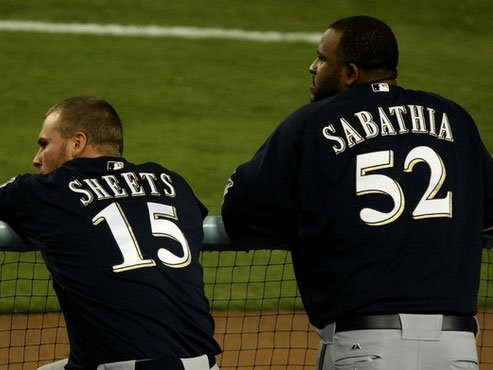
The Yankees would sign CC Sabathia.
And, a bunch of seemingly intelligent sports fans / professional analysts would look at Sabathia's deal and squawk about how baseball needs a salary cap.
Bullfeathers.
Hating the Yankees is something of a national pastime. With the rest of the economy sputtering, their opulent new stadium and lavish free agent spending spree - which started with Sabathia's $162 million deal, continued with A.J. Burnett's $82.5 million pact and could continue in the coming weeks -- makes them an easy target for sniping in the sports blogs and columns, where the logical leap looks like this:
The Yankees are rich. They are signing top players to ridiculous contracts. We need to stop the madness. We need a salary cap.
Their intentions may be noble, but people who think a salary cap will restore competitive balance to baseball really have not been paying close attention. Which team represented the American League in the World Series two months ago?
Go ahead, say it... it's OK.
That's right - the TAMPA BAY RAYS.
They didn't beat Philadelphia, but the budget-conscious Rays played for baseball's biggest prize while the Yankees sat out the tournament.
The Yankees have not won the World Series since 2000. They've had the highest payroll every year since then. They've had the best player in the game, Alex Rodriguez, since 2004. Nevertheless, they haven't won the big one.
People who scream about the lack of "competitive balance" in baseball ignore the fact that the sport has produced eight different champions in the past nine years. Since baseball instituted revenue sharing, clubs like Arizona, Florida, Houston, Colorado, Detroit and Tampa Bay have competed on the game's ultimate stage.
True, the Yankees are on a ridiculous spending spree this winter. However, it comes after they shed nearly $90 million in payroll consumed last season by Jason Giambi, Bobby Abreu, Mike Mussina, Carl Pavano and Andy Pettitte. With a massive investment in their new $1.3 billion stadium and much of their revenue tied to sponsor dollars, attendance (4.3 million last year) and ratings for the YES Network, the Yankees really had no choice but to spend a lot of cash this off-season.
Let's look at some numbers.
The Yankees make about $400 million in revenue, a figure that could rise when they move into their sparkling new stadium. They spend about $200 million on payroll. That's not grossly out of whack. In sports with salary caps, players generally receive about 55 to 60 percent of gross revenues.
In baseball last year, that figure hovered somewhere around 45 percent.
Given the track record of Don Fehr and the player's union, it's highly unlikely that baseball owners would share less of the pie than owners in other sports. Therefore, it's quite likely that a baseball salary cap would actually lead to an increase in the average player's salary and a reduction in owner's profits.
Put it this way: not only would clubs like the Brewers, Twins and Royals be out-bid for superstars like Sabathia, they'd have to pay more for guys like Joe Dillon.
The NBA has a salary cap, which virtually nobody understands, and is probably the least competitive major sports league in terms of the number of teams that can be considered title contenders at the start of each season. In many markets, NBA teams have one or two players making most of the salary cap surrounded by middling players. The system is so complicated that general managers sometimes have to include retired players (Keith Van Horn) in trades in order to balance out the transaction.
The NHL has a salary cap, but the league always seems on the brink of financial ruin. Even though NHL revenues pale in comparison to other sports, that doesn't stop owners from spending "big-league" money for superstars at the top of the player food chain. Although there has been decent turnover in terms of Stanley Cup participants, the league's shaky financial picture makes it difficult for a team owner to "buy" a dynasty.
The NFL has a salary cap, but it has loopholes big enough for Ryan Pickett to run through. The Redskins, for example, have spent ridiculous money on marquee players, but somehow have managed to stay under the cap and avoid winning. The NFL has competitive balance and systematically works to make things tougher on successful teams, but the salary cap doesn't seem to be a major factor in that. Blockbuster trades are uncommon and the "franchise" tag allows teams to keep players who otherwise might bolt to free agency. The best organizations keep their best players and draft and develop players to remain competitive. The crappy organizations make mistakes.
In baseball, it's true that the Brewers, Royals, Twins, Pirates and A's will have trouble competing with the Yankees, Red Sox, Dodgers and Angels for high-priced free agents. But, that doesn't mean they have to stink. If they do well on the player-development side, small-market teams can build competitive teams. The window of opportunity may be shorter and the margin for error much smaller, but it can happen. And, the Yankees actually help the smaller clubs. New York will pay about $100 million to the revenue-sharing fund this season, which will allow small-market GMs to keep up with arbitration raises and try to improve the depth of their benches and bullpens.
It doesn't always work. The Pirates stink. But, they stink because they make bad decisions and not because they are in a small market.
A salary cap might make fans feel better about baseball, but it could end up hurting the final product. You say you want a revolution? Let's talk about eliminating guaranteed contracts, revamping the amateur draft (a huge waste of money).
The salary cap, though, might create more problems than it solves.
Host of “The Drew Olson Show,” which airs 1-3 p.m. weekdays on The Big 902. Sidekick on “The Mike Heller Show,” airing weekdays on The Big 920 and a statewide network including stations in Madison, Appleton and Wausau. Co-author of Bill Schroeder’s “If These Walls Could Talk: Milwaukee Brewers” on Triumph Books. Co-host of “Big 12 Sports Saturday,” which airs Saturdays during football season on WISN-12. Former senior editor at OnMilwaukee.com. Former reporter at the Milwaukee Journal Sentinel.