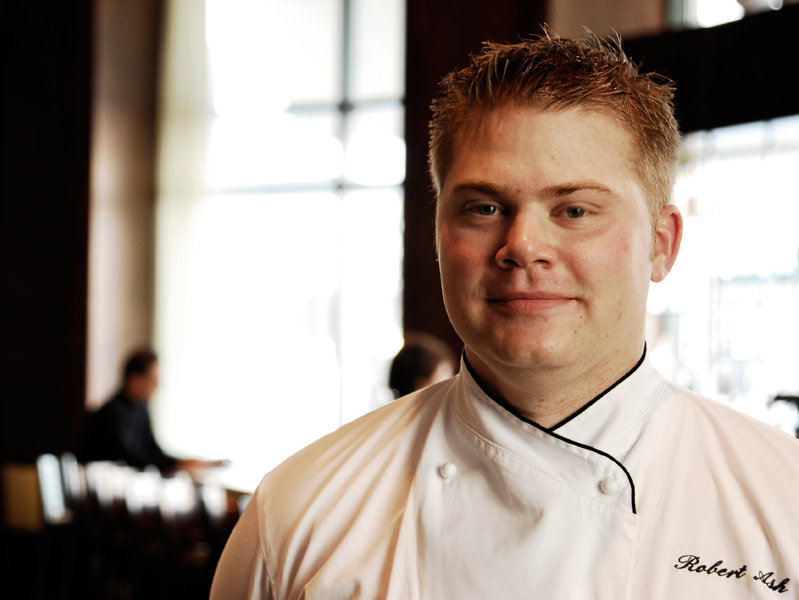


Humble, talented and committed to Milwaukee, Bianchini has quietly marched his Osteria del Mondo into its second decade of excellence while working with his wife, Marta, on Cubanitas and other projects including consultation on the trendy Carnevor on Milwaukee Street.
He's no longer involved at Carnevor, but even in the middle of opening a new restaurant he took time recently to talk food, Downtown, restaurants and life with OnMilwaukee.com's Jeff Sherman. Here is the latest edition of "Milwaukee Talks."
OMC: Why don't you start with your brief life story in two minutes?
Marc Bianchini: Well, I'm a born-and-raised New Yorker. I went to the Culinary Institute of America (1990). I worked in Italy on and off for two years. I worked at some of the better restaurants in New York: La Bernardin, San Domenico.
OMC: Did you know early on that food was going to be part of your life?
MB: When I was 14. After my first job in a restaurant I knew I wanted to be a restaurateur.
OMC: What was that first job?
MB: Making desserts at a local restaurant on Long Island called Crooked Hill. And then I went straight from high school straight into culinary school.
OMC: Were your parents in the restaurant business?
MB: No. My father is a radiologist; mother is in real estate.
OMC: What brought you to Milwaukee?
MB: I came out to Milwaukee to help open up Bartolotta's in Wauwatosa.
OMC: How was that connection made?
MB: Paul (Bartolotta) and I worked together (at San Domenico). I was just getting back from Italy, and what was supposed to be a couple of weeks turned into a couple of months because the chef they hired decided not to take the job at the last minute. So, I was already out here helping and I said I would help a little bit longer to obviously get him off the ground. I didn't want to leave him high and dry.
Next, I went to Chicago, worked for Lettuce Entertain You for about a year. And then I just decided to go and open up my own restaurant, Osteria del Mondo. Next month (on the 17th) marks the 12-year anniversary of Osteria.
OMC: Did you know a lot about Milwaukee when you got here?
MB: Nothing. Zero. I knew it was north of Chicago and that is was where Laverne and Shirley were from.
OMC: What was it like to have your own place?
MB: The early years at Osteria were really interesting in many ways. It being my first restaurant, obviously, there was a lot of passion behind it and that was pretty much the driving force. I wanted to take the gamble at a young age as opposed to waiting because I felt I was ready.
OMC: How old were you when you started it?
MB: Twenty-three when Osteria opened and it was a definite eye-opening experience. You know, it's a lot different when it's your money on the line and Osteria was -- back then -- extremely cutting edge for Milwaukee.
For example, when we first opened we did what the Italians called d'assaggio, which they call amuse bouche now. No one else in town was doing this, and it was a big learning curve because first people would always say, "do I have to pay for this?" And we were, like, "No, this is a little chef's tasting."
OMC: Who helped you build and grow in Milwaukee?
MB: There were several people from Milwaukee who were most influential and who I think helped keep my restaurant going for 12 years. One is Willie Davis, who I became friends with very early on because he had a place in the Knickerbocker. He told me a very valuable lesson. He said, "Remember, Marc, that you do not educate the market. The market dictates what they want and if they want to be educated, then fine; but if they don't want to be, then don't." And I think at that time Osteria was maybe a little too much for the culinary scene, but now it's the status quo. I'm proud that Osteria played a big part in changing the way people dine in Milwaukee.
The other (influential) person was Jay Baker who was the CEO of Kohl's Department Store. He had some valuable business lessons and advice on how to balance your dreams and your visions with the economic reality of what you're facing. There are all those things that we would like to do, but the reality is how can we do it?
MB: There are many different factors, which kind leads into today. (The Milwaukee restaurant scene) is changing. But it's also becoming, you know, extremely difficult to operate restaurants because of many factors. So we are still in limbo. We're still holding onto Milwaukee roots and the old style of dining, but yet now we're pushing the envelope with what I did at Carnevor with the style, the menu there, and what the other gentlemen decided with concept-wise. We did a modern, hip steakhouse, pushed the envelope, and we'll see how that goes.
It's all (about) finding your balance. I think now with this restaurant, Kil@Wat, and with the Wyndham Hotel in general we're bringing something new to Milwaukee that Milwaukee's never seen before. It's been dabbled in before. Hotel Metro was the first and I got to put my hat out to Jamie, but now Marcus Corp. has decided it's time and it's nice to see a company that's deeply rooted in Milwaukee really push for Milwaukee. So I'm really excited about the project.
OMC: What was your role at Carnevor? You're no longer involved in that restaurant, correct?
MB: Right. I'm no longer involved with Carnevor. I was originally planned to have a seven-year contract with them, but it was, I felt, for the direction of my company, more important for me to seek other venues and do other jobs.
I think what we did there was pretty great. However, you need to be on the same page business and philosophy wise. It's not a matter of saying one's right or one's wrong. It's a matter of personal preference. So I guess the best way to, describe it is, what's more important to you as a customer? Is it the special effects of the movie or is it the story line? And I'm very story line driven. I believe in longevity -- that it's not necessarily maximizing what's hot today, but what's going to be hot today and last tomorrow. I think there were those major differences on how a restaurant should operate. So, I just decided that it was best for my company to seek other things.
OMC: How did the Marcus Corporation deal come about?
MB: They hired a gentleman by the name of Larry Flam who had his own restaurant consulting company and worked many years for Lettuce Entertain You and Rainforest. They came to me and wanted to see if it was going to be a good fit. They really wanted to let people know that they're taking the restaurant seriously.
I have two main goals as the culinary director. One is to have excellent food. The other one is to attract broad clientele and let people know that even though these restaurants are inside Marcus Hotels that they're actually very independently driven within the company. They are obviously a division of the company, but the restaurant division has really been separated out and is being focused on to attract diners.
OMC: Will you also be in charge of The Pfister restaurant?
MB: We're taking one project at a time right now.
OMC: So did you have a hand in the design, the concept, the feel, the menu, the whole nine yards?
MB: The décor was done by Mark Knauer. As far as the layout of the menu, that was all mine.
OMC: Where does the inspiration from the menu come from?
MB: We're doing something completely different that has not been done in Milwaukee before where you give people more choices and more options so they can be in control of their dining experience.
We've seen the success of small plates in other markets and the success of steakhouses. What I did was take all those things and said, "What are the good things about these menus and what are the bad things about these menus?"
At a (place like) Craft Steakhouse, of Tom Colicchio's restaurants, he scaled back his menu because he had so many choices, so many options, and he saw that it was okay. It's great to give your customers options, but it needs to be defined.
So our menu here at Kil@wat -- we have styles of food. The menu is laid out by style of food and then it's up to the customer to determine, "Do I just want three courses, do I want five courses, do I want to do a lot of sharing for the table?"
So you literally come in and say, "I like the food that they serve and now I'm going to determine how I eat." One day you can come in here with a group of eight people and never get an entrée and leave full. The next day you can come in with your wife or husband (before you go to a show) and you could be in and out, in under an hour with an appetizer, an entrée and a dessert. The menu is really geared towards what the consumer wants. Tapas, a traditional three-course, a five-course degustation menu, you could do that and you're in control.
OMC: Please discuss some of the specific menu items. I love the cheese and mac.
MB: One of the dishes that I think is just great is the cheese and mac. Obviously the popularity of the mac and cheese is there and the mac and cheese that I won an award on at Carnevor was a huge success there. So, I was brainstorming with a lot of my staff and we came up with an idea to reverse it and do cheese and mac.
So the dish is a stuffed shell with eight different cheeses blended together, some inside the shell and then the other ones outside. Part of the sauce is finished with a black truffle sauce. I really like that one and that's been very well received.
Another one is our caramelized bacon. We take slabs of bacon that we rub down, a whole big, nice slab of bacon, then, caramelize it, serve it with an onion compote and a Port glaze. It is extremely popular. We also do a variation of a Michael Mina dish (Mina has several restaurants in San Francisco and Las Vegas). He made lobster pot pie very famous. I've had the dish and I know Michael and I just did my twist on it. So we have a really awesome lobster potpie, but I definitely want to give him props because he was the one who made it famous. It's simple, but sinfully delicious. And then I think another highlight is our braised short ribs.
OMC: How has the dining scene changed in the last five years and what's good about it, what's bad about it?
MB: It has changed definitely for the better, without a doubt. But with the change there have definitely been some growing pains. I think there are many different new challenges that any restaurateur has whether it's a big corporation like Marcus or a small little restaurant like Cubanitas.
Because the market is demanding new exciting restaurants, I think we're at a point where maybe there are just too many restaurants in the Downtown area. (This makes it) difficult to operate. When I talk to a lot of my colleagues, the number one issue that restaurants have nowadays is staffing and the only reason why it's difficult is because there just aren't enough people. It is an almost monumental task to find a high-quality staff.
I want to step back a second. What makes a great server, a great chef, is being a great customer first. If you go out to eat and you know what it's like to be sitting on the other side and paying that bill, you tend to do a much better job as opposed to somebody who never goes out to eat. And because we are changing and because these restaurants were never here before and because you have companies, you know, like GE and Johnson Controls and Northwestern Mutual bringing people from all over the country, I think that's all been a huge driving force on the restaurant scene and the change.
These executives are demanding better and better restaurants and we're trying to respond. You know, I mean, Bartolotta's, Johnny V's group, my group, On the Marc Restaurants and others out there ... I don't mean to leave anyone out. We're all trying to improve the dining scene, but yet there are challenges and there's no question about it and I'm not going to be shy about it and say that everything is great and it's a hunky-dory situation.
MB: It's just the (population) size of the city. Once the dust settles and when the customers decide which restaurants they want in business and which ones they don't I think eventually we'll get even better.
I think it's at a point where we've come in and now you have the 'burbs competing dramatically with Downtown. (They are) taking away high-quality cooks because they're offering them these wonderful things that large corporations can offer.
Thankfully, my restaurants and other groups similar to mine have an advantage over the smaller independents because we can offer a little bit more flexibility. If we're not busy one night at this restaurant, we're busy at that restaurant and we can shuffle, you know, people over and so that our servers are constantly doing well and making money, you know, our cooks are there.
With Bayshore Town Center opening up they're going to pull several hundred service industry people there and it's going to make the market even tighter, which will make us have to pay more for employees, which will then make it more difficult to run a business profitably.
I predict that within two years, we'll see a much more stable restaurant market in Milwaukee. I think when the construction on the highway is completed, when we see a little bit more positive economic news out there, the Downtown market will definitely be back and better than ever. So it's just a matter of surviving. You know, in the last week a couple of restaurants have closed. It's just a matter of surviving the next year and then I think everything will be fine.
OMC: If you had some kind of magic Milwaukee wand and you could wave it, what are three things that you'd want to see in this area.
MB: Being a born and raised New Yorker, we have a certain reputation about ourselves. If you travel to New York you realize that our abruptness is not necessarily not being polite, it's just that the speed in which things need to happen in New York doesn't allow us to open up the door for somebody. If we open the door, we'll never get in ourselves because there are a thousand people behind you that want to get in there. So I think a lot of people have a misunderstanding of New Yorkers.
But what I would like to see, which is one thing that New Yorkers have, is a little bit more pride in Milwaukee. Being an outsider, I think this city is pretty awesome. I wish more people would talk it up and I think it will become a self-fulfilling prophecy. If people realized what they have here and what people are doing to make it better ... With large corporations like the Marcus' and little corporations too, you know, like the Dogg Haus on Brady Street. You know what I mean? It's just little things like this. Keep talking it all up.
From one end to the other end, you have all these people out here trying to do great things for this city. If everyone said "Let's not fall into the trap of being another city with Cheesecake Factory everywhere," I think we would really have a hot city.
I don't want to be a huge, big city. I want to be, like, a boutiquey Chicago. So, more high end, which seems to go against the trend of the mindset here. I want quality off of quantity and if we had that mentality and are really focused on having quality-driven results. Look at all the great little stores popping up in the Third Ward, you know, things like that are what this city needs. We don't need the big sprawling mall. That's great for the 'burbs because you're going to drive to one area and because of the way it's designed a mall makes sense. But for Downtown, what we have going on are these little neighborhoods, from the East Side, North Avenue to Brady Street to Milwaukee Street, to the Third Ward, we just need to keep supporting that and I think people will realize how good we have it. Look at our lakefront, too, how gorgeous it is.
I decided to stay here and raise my family here. I have two girls. I've got another one on the way. I'm really proud to say that Milwaukee is now my home. I don't want us to lose, and it gets back to my business philosophy -- I believe that it's important that Milwaukee stays true to the story line and not the special effects. I don't want to get caught up in trends and hypes. I want quality. I want to be proud of it.
OMC: Kind of along those same lines, how do you define success?
MB: I define success as doing what makes you happy. Money is nice, but when money is your goal and strictly your goal, it does not bring you success; it brings you convenience. I would say with the success of On the Marc Restaurants with Cubanitas and Osteria and the consultant projects that I've been working on -- have I had significant financial success? Yes, but what makes me happy is doing these projects. I would say doing anything that makes you happy is successful because there's always going to be someone with more money than you, there's always going to be this and that. Success is really just "hey, what did I do for the community?" But then again it's always nice to be lucky too.
OMC: Do you have a couple tips for just the average chef at home?
MB: My biggest tip that I could give anyone who cooks, whether it's at home or professionally, is do not cook with recipes. Recipes should be more like guidelines because if a recipe calls for a jalapeno, well, maybe it needs two jalapenos; maybe it needs only half a jalapeno depending on how hot the jalapeno is. Some days it needs a little bit more of this and a little bit more of that to end up with the same exact result. So I would say that's the number one mistake is everyone measures and follows the recipe.
The second tip is it's whatever you like. Just because you may prefer a little bit more spice than someone else it doesn't mean it's right or wrong. If you want to come into the restaurant and you like your steak well done, well, then it's my responsibility to cook it correctly. Whereas opposed to just charring the hell out of it and sending out a piece of shoe leather, there is a way to cook a steak well and have it still be moist. And if you like it that way, hey, so be it. So don't ever feel obligated to have anything a certain way.
OMC: Any other big projects in the works for you?
MB: We have a couple of things in the works. You know, On the Marc is always looking at new ventures and expansion.
OMC: Are there concepts that are missing from the restaurant scene in Milwaukee?
MB: Yes, I do believe that there are several concepts missing, none of which I will divulge today because I don't want my competitors to know what I'm thinking about.
A life-long and passionate community leader and Milwaukeean, Jeff Sherman is a co-founder of OnMilwaukee.
He grew up in Wauwatosa and graduated from Marquette University, as a Warrior. He holds an MBA from Cardinal Stritch University, and is the founding president of Young Professionals of Milwaukee (YPM)/Fuel Milwaukee.
Early in his career, Sherman was one of youngest members of the Greater Milwaukee Committee, and currently is involved in numerous civic and community groups - including board positions at The Wisconsin Center District, Wisconsin Club and Marcus Center for the Performing Arts. He's honored to have been named to The Business Journal's "30 under 30" and Milwaukee Magazine's "35 under 35" lists.
He owns a condo in Downtown and lives in greater Milwaukee with his wife Stephanie, his son, Jake, and daughter Pierce. He's a political, music, sports and news junkie and thinks, for what it's worth, that all new movies should be released in theaters, on demand, online and on DVD simultaneously.
He also thinks you should read OnMilwaukee each and every day.