
Like you, I live in Wisconsin and I love cheese. And I'm something of a foodie, so I'm always eager to look behind the scenes at cheese factories, wineries and other places where culinary magic happens.
So, I was happy that Kris and Mark Heise – and owner Mark Rolison – let me be cheesemaker – more accurately, cheesemaker's assistant – for a day at Beechwood Cheese in Beechwood, about 10 minutes northeast of Kewaskum.
Driving the country roads to Beechwood was like motoring through paradise, with lush green fields, shallow valleys, gently rolling low rises and pastures dotted with cows.
Beechwood Cheese was founded in 1894 by James and Daniel O'Connel who bought their brother John's cheese factories and combined them at the present location. In 1933, then-owner Walter Linder built the current building and in 11 years later the DeLand Cheese Co. bought the business and put Mark's dad Norbert in charge.
Norbert – who sold his Cheddar, Colby, Brick and Muenster to Borden – was the first to make Monterey Jack in Wisconsin and was the first to test frozen starter cultures, too. When Mark and Kris bought the place in '79, they added the retail shop and created a range of flavored natural cheeses. About seven years ago, they sold the company to Rolison but continue to run it. Beechwood has been featured on an episode of the Food Network's "Road Tasted."
Kris and Mark couldn't be friendlier, welcoming me warmly on a beautiful June morning. I suspect working for them is a pretty good situation to be in.
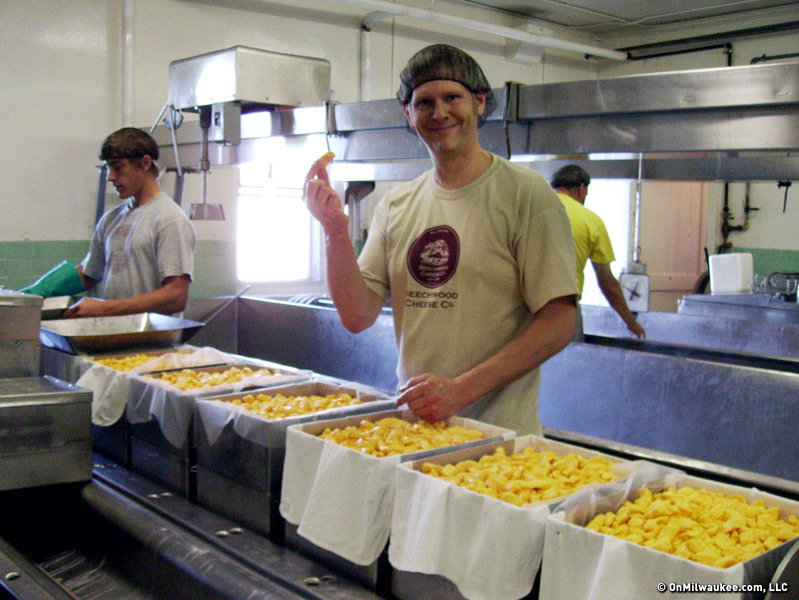
When I arrived Kris gave me a hair net, a Beechwood T-shirt and directed me to the sterilizing sink to render me clean enough to work with the cheese. Meanwhile, Mark and his assistant Brandon Zolp were tossing Cheddar slabs, preparing to shred them into curds.
At 3 a.m. Mark fired up the boiler to pasteurize the milk. The milk was then heated in a tank and frozen starter culture was added. That, says Kris, is what tells the milk that big changes are coming when the rennet is added.
Also, the natural coloring is added to the milk to give the Cheddar its familiar orange color. The color is added to the milk, rather than the curds, to make sure that it is evenly distributed.
Within 20 minutes the rennet gives the heated milk the consistency of Jell-O, melding together tiny curds called fines. It continues to be heated to cook off some of the moisture and then it is sliced with long-handled slicers.
Cheddar slabs are the result. And this is where I came in. We tossed the slabs into a big open-top tank to get them ready for shredding into bigger "curds" – like the ones you buy in the store. The slabs aren't very heavy, but they're not light and you've got to bend at the middle to pick them up. So, right away, I realized that cheesemakers not only work long hours, but they work hard, too.
Next, we fed the slabs into a shredder, and the curds covered the bottom of the tank, which is pitched toward the middle to allow more whey to come off. The whey is fed into a machine that separates the cream from the water. The former is sent to a local ice cream maker and the water is recycled for a variety of uses, including for animal feed.
Working elbow-deep in curds really gets you close to the cheese and it's easy to see why artisan food makers are so passionate about their products.
With shovels, we turned over the curds and moved the ones from the edges of the tank to the center; again, to help the machine ensure fairly uniform curds and no clumping.
Then Mark salted the curds and we – and the machine – continued mixing. It's important that most of the moisture is off the curds before salting or the salt would run off with the excess. It's also extremely important that the salt is evenly distributed. If not, the cheese will appear mottled because the salt reacts with the cheese.
While Mark and Brandon started putting curds into molds to make 40-pound Cheddar blocks for a customer in Indiana, Kris and I filled some small plastic bags with curds for the retail shop. Some of those curds get flavored and I added the Penzey's spices to a big bag of curds and mixed them up to create some shallot and black pepper curds.
Then I joined in to help Brandon fill molds. Mark scooped up buckets of curds and weighed them to ensure uniform blocks. To make a 40- or 42-pound block, we needed to pack in 47 pounds of curds. When they are pressed overnight, the loss of moisture and air will get them to their proper weight.
We put a bucketful of curds into the mold and punched them down, then added a second bucketful and punched them down more. Then the cheesecloth that lines the molds is folded over the top and a metal lid is put on.
Mark put the molds into the press and set the pressure. The next morning, the blocks will be ready.
The blocks are sent to wholesalers or carved up here and packaged for retail sale in places like Sendik's and the Outpost in Milwaukee, as well as farmers' markets in West Bend, West Allis and Bay View's South Shore Park. Sprecher also sells packets of curds at the end of its brewery tours. One of Beechwood's most talked-about products is Kris' chicken soup cheese.
In the meantime, I thought about how rewarding it must be to be a cheesemaker – but also how much hard work goes into making something most of us take for granted – and Kris and I spent some time bagging, weighing and pricing bags of curds for the retail shop.
All the while, other employees filtered in and quietly started going about their business. Customers began to come into the shop and Kris and Mark know them all. There's the couple from New Jersey who live in an old church out east and now also own an old church in Beechwood that they're renovating.
Some former ballplayers Mark coached when he led the Random Lake baseball team to multiple state titles stop in, too. One is back from college in Minneapolis and the other, tanned, is fresh out of boot camp.
There's work to be done at Beechwood and everyone was doing it, but what makes it so special – other than the delicious cheese – is the neighborly vibe that permeates the place.
Stop in, especially the first Saturday of the month for the popular Cheese Curd Day when you can buy curds basically right out of the tanks, and you'll see what I mean. When you get there, tell Kris I said howdy.
Born in Brooklyn, N.Y., where he lived until he was 17, Bobby received his BA-Mass Communications from UWM in 1989 and has lived in Walker's Point, Bay View, Enderis Park, South Milwaukee and on the East Side.
He has published three non-fiction books in Italy – including one about an event in Milwaukee history, which was published in the U.S. in autumn 2010. Four more books, all about Milwaukee, have been published by The History Press.
With his most recent band, The Yell Leaders, Bobby released four LPs and had a songs featured in episodes of TV's "Party of Five" and "Dawson's Creek," and films in Japan, South America and the U.S. The Yell Leaders were named the best unsigned band in their region by VH-1 as part of its Rock Across America 1998 Tour. Most recently, the band contributed tracks to a UK vinyl/CD tribute to the Redskins and collaborated on a track with Italian novelist Enrico Remmert.
He's produced three installments of the "OMCD" series of local music compilations for OnMilwaukee.com and in 2007 produced a CD of Italian music and poetry.
In 2005, he was awarded the City of Asti's (Italy) Journalism Prize for his work focusing on that area. He has also won awards from the Milwaukee Press Club.
He has be heard on 88Nine Radio Milwaukee talking about his "Urban Spelunking" series of stories, in that station's most popular podcast.