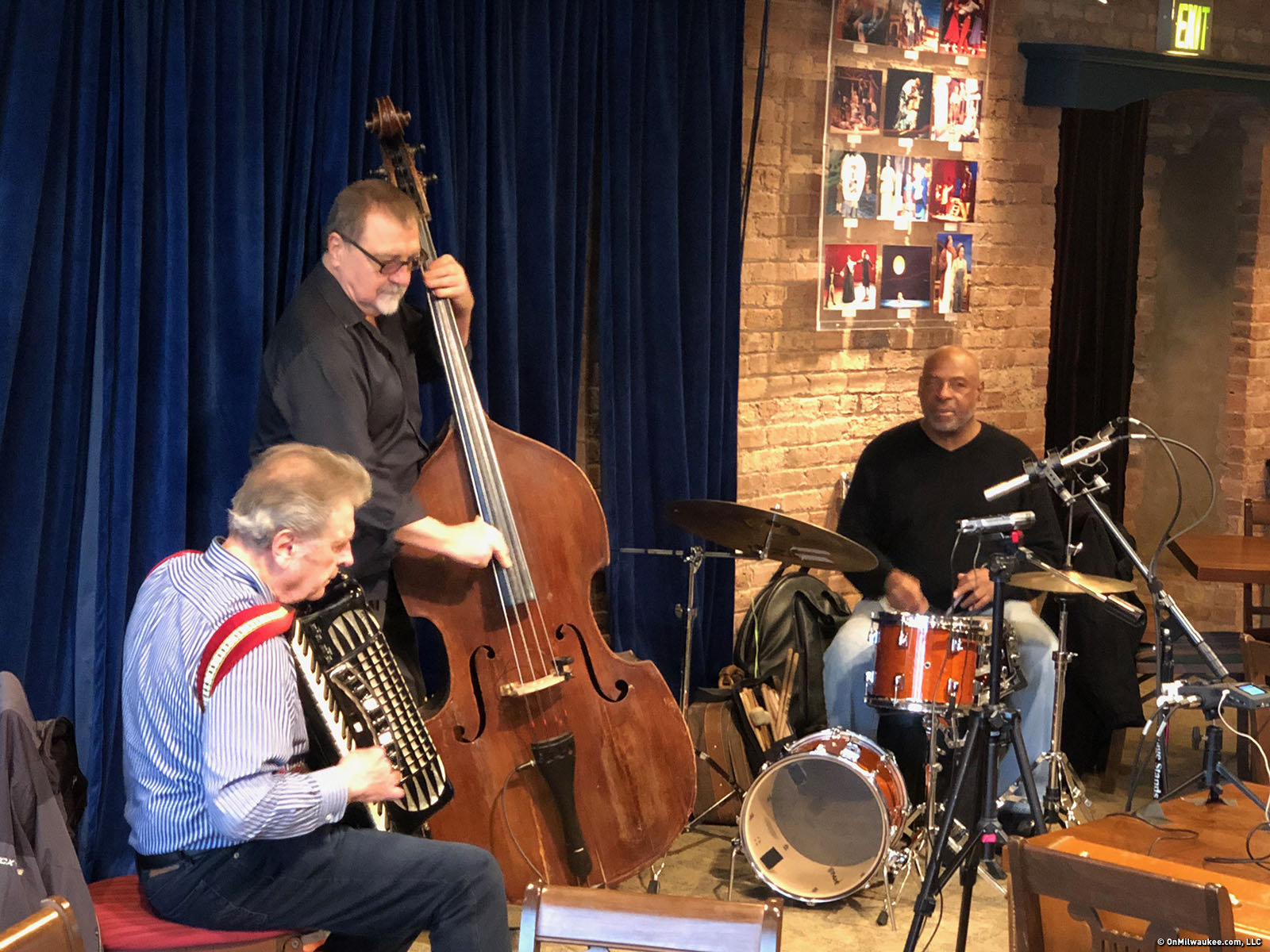


The Pabst Theater was abuzz with excitement as Ahmad Jamal, James Cammack and Idris Muhammad prepared to take stage and their audience sat ready to be captivated.
Pianist Jamal is well known to jazz fans and an influence on his peers. But, as popular music moves along, he and the other artists that created classic albums in the 1950s, '60s and '70s are fading away from the spotlight.
Introducing his classic song "Poinciana," Jamal joked that most listeners knew the song only because Clint Eastwood chose to use it for his film “The Bridges of Madison County.”
"Jazz (has) entered the pantheon that it’s a classic form of music. It’s been given a golden status by our society," says Andy Noble, area DJ and co-owner of Lotus Land records. "There will always be a jazz club or bar in cities.
"Jazz lives on in other forms of music, such as hip-hop, which contains a fair amount of jazz samples."
Producers such as Pete Rock, Madlib, Q-Tip, and DJ Premier are but a few hip-hop artists who have used jazz samples in their music. Both Jamal and Muhammad have had some of their music sampled -- Jamal’s music was used on “Illmatic” by Nas, and Muhammad’s by Ghostface Killah on "Ironman."
That era of hip-hop peaked in the ‘90s, but still has a devoted following today. That doesn’t mean, however, that people are necessarily interested in finding the music that these producers have sampled.
"Kids these days don’t like jazz, at least in my experience," Noble says. "Classic bebop is not something that you grow up with socially."
Lack of radio airplay
One reason, perhaps, is a lack of radio airplay for jazz music. Milwaukee listeners used to be able to tune in to 88.9 for their jazz music fix, but that stations recently changed formats and it’s too early to tell if jazz will have a spot in the rotation.
Brent Goodsell, who DJs with Noble and owns Neapolitan records, says that: "Radio is a commercial industry, so demand will drive (what gets played)."
Even Smooth Jazz 93.3, which was never a station for straight-ahead 'hard-bop' jazz, or 'fusion' jazz of the '70s, recently announced that it would drop "jazz" from its moniker. Although the music played on that station was a very distant cousin of jazz, the switch illustrates how far the music has strayed off the mainstream radar.
People do buy jazz records locally, but Noble says they choose, "more of the funky jazz. The straight-ahead bop era is a dying market. Literally. People who collected it are getting older…"
So, perhaps it is significant that Jamal is still performing.
Other influential jazz musicians, such as guitarist Grant Green passed away before people in their 20s were even born. Thelonious Monk died in 1982, Miles Davis in 1991. Within the past few years, the jazz community has lost Jimmy Smith and Alice Coltrane, to name but two. An entire generation has grown up without the opportunity to see these icons live on stage.
The institutionalization of jazz may be to blame
Furthermore, there has not been an abundance of successors to fill the shoes of John Coltrane, Sun Ra, Duke Ellington and other milestone jazz artists.
In some ways, the institutionalization of jazz may be to blame.
“Many jazz musicians in the ‘60s had minor formal education,” Goodsell says, “they didn’t go to college to learn jazz.
“It’s really sad,” Goodsell continues, “all the young jazz musicians I lived with in New York decided to learn jazz in school. They were atrocious, it was jazz at the lowest level.”
Compare that to an artist like Jamal, who has had years to hone his craft on stage, alongside other musicians, playing a variety of styles of jazz. He needed only to point a finger at Muhammad or Cammack and they would be on their own to improvise, while Jamal would rise from his bench while they performed, watching intently. When it was his turn to take a solo, he simply pointed to the sky, smiled - occasionally letting out a shout -- and played on. The music was coming from the soul. It was not clinical, classroom jazz.
Jazz in Milwaukee
Gone are the days when jazz clubs lined the streets of Downtown and Bronzeville, as in the '40s and '50s. Gone even are the days when Ron Cuzner could maintain a Downtown record shop entirely devoted to jazz, as he did in the late 1980s and early '90s.
As to whether or not there is interest in local DJs spinning jazz music, Noble notes that: "Tom (Noble’s brother) and I had a 'Freedom Jazz Dance' night at The Estate a few years ago. It wasn’t popular.'
Goodsell says that: "Most people have a very bad impression of jazz, they think of it as background music."
However, he adds: “You can play any type of music if you do it at the right situation and do the correct cuts. What’s played in my shop is 90 percent jazz, even though that is 5 percent of what sells.”
Goodsell pauses a moment to pull out a local jazz album from the 1970s: The Ray Tabs Trio’s “I’m in Love With You.” We listen for a bit, then he pulls out a James Dallas LP from 1982.
"There is interest in these records from Japanese collectors,” he notes.
He then takes a few seconds to look through his crates, and finds another group of local jazz records, such as Billy Anderson’s "Billy’s Back."
"He played in Lake Geneva, but who knows what happened to him,” Goodsell says. "This album is probably from the '70s.”
Goodsell plays one more record for us. The Baron von Ohlen Quartet, which is not a Milwaukee record, but a very rare Stan Kenton record. However, he explains that there is a local tie-in as one of the vocalists was a model for Phoenix hosiery.
He says he could "imagine playing something like this at Mad Planet. Local jazz is interesting."
That it is. And while much of the jazz from the past locally, it has gained a following overseas, in particular, Japan. The albums of the past will still live on for collectors to find.
And local jazz still lives on today, with artists like Berkeley Fudge and Jack Grassel. Fans of the genre interested in live jazz in Milwaukee can visit Jazz in the Park throughout the summer. The jazz club The Estate frequently has live music, and in time perhaps local radio will bring the music back to the airwaves.
Until then, iTunes, used CD and record stores, eBay and online sources have thousands of hours of jazz, just waiting to be discovered.