
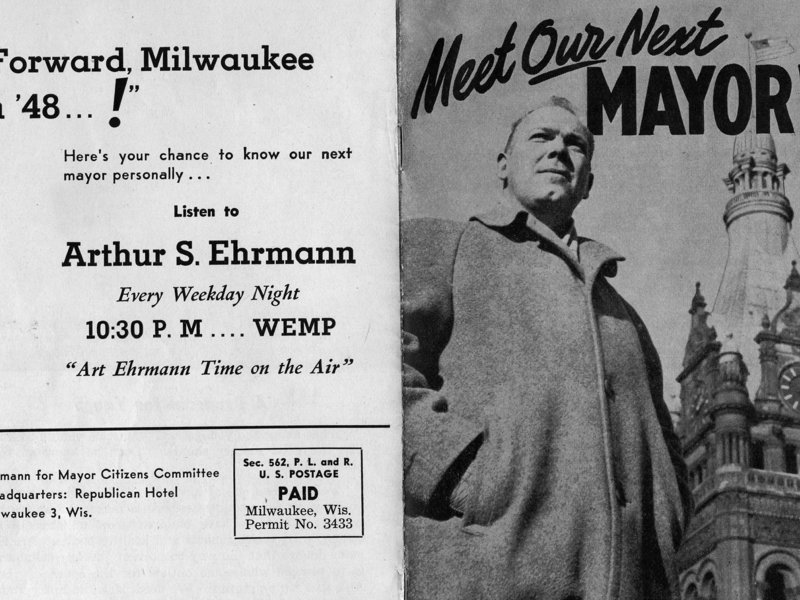

Arthur S. Ehrmann, 35, is a big, jolly assistant city attorney and the city's legislative counsel or lobbyist at Madison. He graduated from Marquette Law School in 1934, practiced in Milwaukee, was appointed to the city attorney's staff in 1941, enlisted in the Navy in 1942, took part in the invasions of Sicily and Normandy. He was president of the Eagles Club before entering service. At that time, he weighed 265 pounds, but the Navy reduced him to 240 in one month.
Exactly what my father's single month loss of 25 pounds in the U.S. Navy had to do with his campaign for Mayor of Milwaukee in 1948, I'm not sure. But I'll bet it was Dad who provided that information to the newspaper. It was the kind of offbeat, self-deprecating detail he got a kick out of disclosing about himself.
He was the funniest, smartest and best man I ever knew. His character and integrity were rare and stunning. He was a favorite to become mayor 64 years ago, but it didn't happen (he lost in the primary). Dad didn't talk about it much, but once when I asked why he never ran for public office again he said, "Because you can't be honest and win."
Before he died in 1975, he did say he regretted having never become a judge – but not because it was something he wanted for himself but rather because he thought his seven children would've been tickled to have a judge for a dad. It wouldn't have impressed us any more than we already were.
I was five or six when Dad bought my first baseball glove, and one for my brother, a year younger than me. He got them at the old Mid-City Sporting Goods on 27th and Wisconsin, a few blocks from where Dad worked at the old Eagles Club. Knowing how much we looked forward to those gloves, instead of making us wait 'til he got home from work with them that evening, he called a cab and had the driver deliver the gloves to us right away.
In a high school debate class my first project was to construct the affirmative side of the argument, "Common stocks make a good investment." As usual, I waited 'til the night before to worry about it, and was sitting at the kitchen table fumbling through the S volume of our Compton's Encyclopedia when Dad passed through on his way to the john. He asked what I was up to, and when I told him he stood there for 20 minutes and recited off the top of his head arguments, in perfect outline form, in favor of the proposition. He never personally invested a dollar in the stock market that I'm aware of. The next day when I read his outline verbatim in class, I not only won the debate but the veteran coach said it was the best argument in favor of common stocks he'd ever heard.
It wasn't common stock certificates but a few fake $50 bills Dad quietly dropped in the aisle at Holy Cross Church while returning from communion one Sunday. "Now we'll see who's concentrating on the Miracle of the Eucharist," he said. There were some spectacular pile-ups.
When I was 20 and spent a week in the hospital, on my second day there they delivered 15 letters addressed to me. All but one of them contained a blank sheet of paper. In the other one was a note from Dad explaining that he was mailing the rest to impress the hospital staff with what a big shot I was.
In addition to being a lawyer, Dad was a fabulous writer and the editor of an international fraternal magazine. In the early 1970s I had a succession of summer internships in Washington, D.C., working as a reporter. When I wrote a letter home one day full of scathing complaints about changes made in my copy, I did not get the sympathy I expected.
"...On the inviolability of written copy, you and I may differ somewhat," replied Dad in his return letter. "In my book the very nature of the operation gives the editor not only the right but the obligation to change copy into the form that strikes his fancy. That's what editors are for. In fact, it has always been my opinion that a publication should over the stretch express the personality and the prejudices and the policies of its editor. And it has also been my opinion that all submitted copy is subject to cutting, changing, being added to, all this at the whim of the editor.
"...I can remember when we got for our little old magazine a lot of articles by James T. Farrell, for more than 40 years the holder of some sort of literary reputation for his many novels. I thought his articles were awful and pretty thoroughly redid them. The intellectuals at the office said, 'You're not going to have the audacity to edit James T. Farrell!' And I said the hell I'm not; this is my magazine and in fact I'll rewrite him, and I did. And each time Jim Farrell would write me a note and say he liked the way the article was handled."
Politically, Dad was an Adlai Stevenson/Hubert Humphrey Democrat. But in 1972, when the donkey party veered far left under George McGovern, he held his nose and pulled the Republican lever. "In all the nonsense that is going on," he wrote to me, "unless a guy is to wind up on the side of the kooks, lefties and incompetent opportunists, he has to choose up sides somewhere. But wouldn't it be wonderful if somehow he didn't have to pick Nixon?"
After I got a journalism degree I scored a job interview with a newspaper in the South. The editor arranged for me to pick up my airplane ticket at Mitchell Field just before my flight. But I left my wallet at home that day and didn't make the flight because without identification they wouldn't give me the plane ticket. I steeled myself for a long lecture about personal responsibility when I got home, but Dad got the point across simply by addressing me for the next couple weeks as "Mr. X."
I prefer to think that Frank Zeidler, who won the 1948 mayor's race, served 12 years and today is regarded as one of Milwaukee's best mayors, wasn't just being kind when we met in 1973 and he said, "If I'd known then the kind of man your dad is, I would have withdrawn in his favor."
In German the name "Ehrmann" translates to "honorable man." Born 100 years ago today, Art Ehrmann was the epitome of that.


.jpg)

